Choosing a newspaper ad size looks simple until you actually start planning the advertisement.
Should you choose a classified text ad, a small classified display, quarter page, half page or full page? And when a newspaper quotes a rate per square centimetre, how do you calculate the space you are buying?
The first thing to understand is:
There is no single universal newspaper ad size that applies to every publication in India.
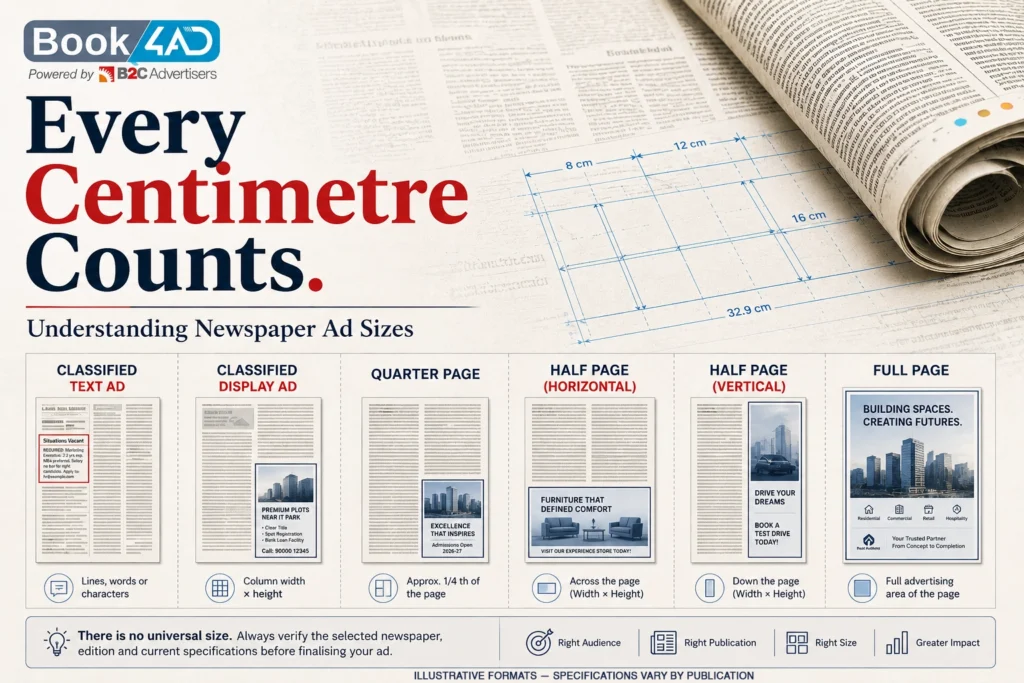
Page dimensions, column widths, minimum accepted sizes and fixed advertising formats can vary between newspapers. For example, current Times of India specifications list a full page at 329 × 525 mm, a quarter page at 160 × 250 mm, and a horizontal half page at 329 × 250 mm. (Specle)
So use standard sizes to plan your advertisement, but always confirm the final dimensions for the selected newspaper and edition before preparing production artwork.
Newspaper Ad Sizes — Quick Guide
| Ad Format | How Size Is Usually Determined | Common Use |
|---|---|---|
| Classified Text | Lines, words or characters depending on publication | Matrimonial, property, recruitment, announcements |
| Classified Display | Fixed column width × height | Property, recruitment, matrimonial, notices |
| Display Ad | Width × height / sq cm or fixed format | Retail, education, real estate, branding |
| Quarter Page | Publication-specific fixed/approximate format | Product, retail, property, education campaigns |
| Half Page | Horizontal or vertical format | High-visibility campaigns |
| Full Page | Publication’s full printable advertising area | Launches, major announcements, brand campaigns |
The important difference is that a classified text ad is not planned like a display advertisement.
Let’s understand each format separately.
1. Classified Text Ad Size
A classified text advertisement is the smallest and simplest newspaper advertising format.
You commonly see these under categories such as:
- Matrimonial
- Property
- Recruitment
- Name Change
- Lost & Found
- Public Notice
- Services
- Personal Announcements
Unlike display advertising, classified text ads usually don’t begin with a physical size such as 8 cm × 5 cm.
The publication may instead charge according to its own line, word, character or package rules.
For example, The Times of India currently states that its classified text advertisements are charged for a minimum five lines, with additional charges for extra lines. Remembrance advertisements have a different minimum.
That is a Times of India rule, not a rule that should automatically be applied to every Indian newspaper.
Book4Ad Tip
Before shortening your advertisement simply to reduce its size, check how the selected publication actually calculates the charge.
Removing an important location, qualification, property detail or contact instruction just to save one line can make the advertisement less useful.
2. Classified Display Ad Sizes
A classified display ad sits between a text classified and a larger display advertisement.
It allows greater visual flexibility, including elements such as:
headline + different type sizes + border + logo + structured information + visual hierarchy.
These ads are commonly used for:
- Recruitment
- Property
- Matrimonial
- Education
- Public notices
- Remembrance
- Business announcements
Classified display sizes generally depend on the newspaper’s column structure.
A real publication example
The Times of India currently specifies:
Single-column classified display:
3 cm width × minimum 5 cm height
Multi-column classified display:
standard widths of 6.34 cm, 9.66 cm or 12.98 cm × minimum 5 cm height. (Times of India Ads)
Again, these dimensions illustrate how one publication structures classified display advertising. Other newspapers can have different column widths and minimum sizes.
Why does this matter?
Suppose you design a beautiful advertisement at:
8 cm × 5 cm
and later discover that your selected newspaper accepts a particular classified-display product only in its predefined column widths.
The artwork may need to be resized or redesigned.
So the better workflow is:
Choose publication → choose edition/category → confirm permitted size → then prepare final artwork.
Not the other way around.
3. Display Newspaper Ad Sizes
Display advertisements offer much greater freedom in layout and visual communication.
They may include:
- photographs
- illustrations
- branding
- logos
- multiple headlines
- product information
- offers
- addresses
- QR codes where appropriate
- detailed calls to action
Display advertising can range from relatively small custom-sized advertisements to:
Quarter Page → Half Page → Full Page → premium/innovative formats.
Depending on the publication, display advertising may be sold using square-centimetre rates, column-based dimensions or fixed advertising formats.
4. Quarter-Page Newspaper Ad Size
A quarter-page advertisement occupies approximately one-quarter of the available newspaper page advertising area.
But “quarter page” does not guarantee one universal dimension across every newspaper.
As a useful real-world reference, current Times of India specifications list its quarter-page format as:
160 mm × 250 mm
or approximately
16 cm × 25 cm. (Specle)
Other newspapers may use different page dimensions or specifications.
When does a quarter page make sense?
A quarter page provides enough space for:
- a strong headline
- one dominant image
- product/project information
- important benefits
- branding
- contact details
without requiring the investment of a half or full page.
It can therefore be useful for campaigns such as:
real estate, education, retail, healthcare, events and local brand advertising.
But don’t choose quarter page merely because it sounds impressive.
Choose it when the message actually needs that amount of space and visibility.
5. Half-Page Newspaper Ad Size
Half-page advertisements generally appear in one of two orientations:
Horizontal Half Page
A wide advertisement spanning much of the newspaper page width.
As a current TOI reference:
329 mm × 250 mm
or approximately
32.9 cm × 25 cm. (Specle)
Vertical Half Page
A tall format occupying approximately half the page in a vertical orientation.
The exact accepted dimensions must be confirmed with the selected newspaper.
Horizontal or vertical — which is better?
Neither is automatically better.
A horizontal format can work well when the communication needs:
wide imagery + multiple products + landscape property visuals + broad visual hierarchy.
A vertical format can work better for:
portrait imagery + structured information + tall product photography + sequential storytelling.
The creative idea should influence the orientation—not simply habit.
6. Full-Page Newspaper Ad Size
A full-page advertisement uses the publication’s full available advertising area.
For example, current Times of India specifications list:
329 mm × 525 mm
or approximately
32.9 cm × 52.5 cm. (Specle)
Do not assume those exact dimensions apply to another newspaper.
A full page provides maximum creative space, but it also creates a bigger creative responsibility.
A full page filled with:
too much text + too many photographs + multiple competing headlines + several CTAs
can still perform poorly.
More space should create better communication, not simply more content.
7. Is There a Standard Newspaper Ad Size in India?
Not one universal size.
Different newspapers may use different:
- page dimensions
- printable areas
- number of columns
- column widths
- gutters
- classified-display rules
- fixed-size products
- premium-position specifications
This is also why apparently authoritative websites can show slightly different dimensions for what they call a quarter page or full page.
The correct specification is ultimately the one accepted by the publication/product being booked.
Practical rule
Use common newspaper sizes for:
planning → budgeting → concept development.
Use publication-confirmed dimensions for:
final artwork → production → submission.
8. How Is Newspaper Ad Size Calculated?
This is where newspaper advertising becomes much easier once you understand the basic calculation.
For many display products:
Ad Area = Width × Height
Suppose your advertisement is:
8 cm wide × 5 cm high
Then:
8 × 5 = 40 square centimetres
So the advertisement occupies:
40 sq cm
If the applicable advertising rate were ₹X per sq cm, the basic space calculation would be:
40 sq cm × ₹X
However, that does not necessarily equal the final payable amount.
Depending on the newspaper and booking, the final amount may also be affected by:
- colour
- page position
- edition
- category
- premium placement
- package/combo
- taxes
- applicable scheme or commercial terms
Therefore, don’t calculate the final booking price from dimensions alone.
9. What Does “Per Sq Cm” Mean in Newspaper Advertising?
Sq cm means square centimetre.
An 8 cm × 5 cm advertisement is:
40 sq cm
A 10 cm × 10 cm advertisement is:
100 sq cm
A 12 cm × 20 cm advertisement is:
240 sq cm
Square-centimetre measurement is widely used in Indian newspaper advertising. Government newspaper-rate documentation has also historically recognised square centimetres as a standard advertising unit where changing newspaper/column dimensions make fixed column assumptions unreliable. (DAVP)
Some publishers may still use column-centimetre concepts operationally or for material specifications. For example, Dinamalar’s current tariff states that billing uses square centimetres while material is submitted in column-centimetre format.
So always read the selected publication’s rate/specification carefully.
10. What Is Column × Centimetre?
Newspapers are built around columns.
Instead of allowing any arbitrary width, a publication may require the advertisement to occupy:
1 column
2 columns
3 columns
4 columns, etc.
The height is then specified separately.
Conceptually:
Column width × height = advertising space
But the physical width of a column is not universal across all newspapers.
That’s why you should never tell your designer:
“Make it two columns.”
without also specifying which publication.
Two columns in one newspaper may not have exactly the same physical width as two columns in another.
11. Fixed Size vs Custom Size Newspaper Ads
Another useful distinction is between fixed-size and custom-size advertisements.
Fixed-Size Ads
The newspaper defines a particular format.
Examples can include:
quarter page
half page
full page
specific premium formats.
The dimensions are predetermined for that publication/product.
Custom-Size Ads
The advertiser selects an allowed width and height within the newspaper’s specifications.
This can provide more control over budget.
For example, instead of automatically purchasing a quarter page, an advertiser may find that a well-designed smaller display advertisement communicates the message perfectly.
That’s why size planning should come before creative production.
12. What Newspaper Ad Size Should You Choose?
Don’t start with:
“What is the biggest ad I can afford?”
Start with:
“What does the reader need to notice and understand?”
Consider six things.
1. Objective
Are you trying to:
generate enquiries, announce something, recruit people, sell property, build awareness or communicate a legal/public notice?
Different objectives require different space.
2. Amount of Information
A simple rental requirement may need very little space.
A real-estate launch with:
project image + location + configurations + price communication + amenities + RERA information + branding
may require substantially more.
3. Visual Requirement
If your advertisement needs a photograph, product image, project rendering or strong brand identity, classified text is unlikely to be sufficient.
4. Audience
The right publication and edition can matter more than simply increasing the ad size.
5. Budget
A smaller advertisement with excellent hierarchy can sometimes be more efficient than a larger advertisement with weak communication.
6. Frequency
Sometimes:
smaller advertisement × multiple insertions
may suit the campaign better than:
one very large advertisement.
There is no universal answer. It depends on the objective.
13. Newspaper Ad Size by Requirement
Matrimonial Advertisement
A straightforward matrimonial requirement can often begin with classified text.
Choose classified display when you need stronger visibility, structured presentation or permitted visual elements.
The correct choice depends on publication/category rules and the amount of information.
Property Advertisement
For an individual property sale or rental:
classified text or classified display may be sufficient.
For a builder/project campaign:
larger display advertising may be appropriate because photography, location, project information and branding need more space.
Recruitment Advertisement
A single vacancy may require only a compact advertisement.
A large recruitment drive with:
multiple positions + qualifications + locations + application instructions + employer branding
may require a larger classified display or display advertisement.
Public Notice
Here, readability and required information come first.
Don’t reduce the advertisement so much that mandatory matter becomes difficult to read.
Where a legal, institutional or statutory requirement applies, confirm the required publication, content and format before booking.
Retail or Brand Campaign
Retail and brand campaigns usually need stronger visual communication.
The size should accommodate:
headline + product/service + key proposition + branding + response information
without making the design crowded.
14. Does a Bigger Newspaper Ad Always Get Better Response?
No.
Size can improve visibility, but response depends on several factors:
right newspaper
right audience
right edition
right category
right publication date
clear message
strong creative
useful offer/proposition
easy response method.
A large advertisement cannot compensate for poor targeting.
Likewise, an extremely small advertisement cannot communicate effectively if the reader needs too much information.
The goal is not:
maximum size.
The goal is:
the right amount of space for the communication job.
15. Newspaper Ad Artwork Checklist
Once the size is confirmed, the artwork itself matters.
Before sending a newspaper advertisement for publication, check:
Correct Physical Dimensions
Prepare the artwork at the final publication-approved size.
Don’t design a random proportion and expect the newspaper to resize it perfectly.
Image Resolution
Images intended for newspaper production should normally be prepared at suitable print resolution. Book4Ad’s production workflow generally targets 300 dpi artwork where appropriate.
Colour Mode
For colour newspaper advertisements, final production artwork should follow the publication’s required print specification.
For example, current Times of India production specifications listed by Specle call for CMYK and identify PDF/X-1a:2001 as the PDF standard. (Specle)
Different publications may specify different production requirements.
Text Size
Don’t squeeze too much copy into a small advertisement.
If reducing the ad size makes important text difficult to read, either:
reduce the content or increase the space.
Logos
Use the original approved logo asset.
Never stretch, redraw or use a low-quality screenshot of a logo in production artwork.
Final Proof
Check:
names
phone numbers
dates
addresses
prices
legal numbers
spelling
dimensions
colour
images
contact information
before approving publication.
A small error in a print advertisement cannot be corrected after the newspaper has been printed.
16. A Simple Size-Planning Example
Suppose a local business initially asks for:
“Give me a quarter-page ad.”
Before choosing the size, ask:
What are we advertising?
Suppose the actual requirement contains only:
- business name
- one strong headline
- one product photograph
- three benefits
- address
- phone number
A professionally designed custom-sized display advertisement might communicate this perfectly without needing a quarter page.
Now imagine another advertiser needs:
- project photograph
- location map
- multiple configurations
- pricing
- amenities
- statutory information
- developer branding
- contact details
Trying to squeeze that into a very small advertisement would damage readability.
Content requirement should influence size—not habit.
17. Before You Finalise a Newspaper Ad Size
Use this simple sequence:
1. Choose the advertising objective
↓
2. Choose the newspaper and edition
↓
3. Choose classified text, classified display or display
↓
4. Confirm permitted dimensions
↓
5. Compare the cost
↓
6. Prepare artwork at the confirmed size
↓
7. Preflight and approve
↓
8. Publish
This avoids one of the most common newspaper-advertising mistakes:
designing first and checking the publication specification later.
Frequently Asked Questions
What is the standard newspaper ad size?
There is no single standard advertising size that applies to every Indian newspaper. Publications use different page dimensions, column structures and advertising products. Always verify the selected newspaper’s current specification.
What is a quarter-page newspaper ad size?
It varies by publication. As one real-world reference, current Times of India specifications list a quarter page at 160 × 250 mm (16 × 25 cm). (Specle)
What is a half-page newspaper ad size?
Half-page advertisements can be horizontal or vertical, and dimensions vary by publication. TOI currently lists its horizontal half page at 329 × 250 mm. (Specle)
What is a full-page newspaper ad size?
It depends on the publication. TOI’s current listed full-page specification is 329 × 525 mm. This should not be treated as the universal size for every Indian newspaper. (Specle)
What size is a classified newspaper ad?
Classified text ads are often charged according to lines, words or characters rather than a physical centimetre dimension. Classified display advertisements use physical dimensions based on the publication’s column structure.
How do I calculate newspaper ad size in square centimetres?
Multiply:
width in cm × height in cm
For example:
8 cm × 5 cm = 40 sq cm.
Is classified display the same as display advertising?
No. Classified display appears within classified advertising sections/categories and usually follows specific column/size rules. Main display advertising provides broader creative and placement possibilities.
Should I design the advertisement before choosing the newspaper?
Preferably not. First choose the newspaper, edition and advertising format and confirm its dimensions. Then create the final artwork to the accepted specification.
The Right Newspaper Ad Size Is the Size Your Message Needs
Newspaper advertising isn’t simply a choice between small, quarter page, half page and full page.
The right decision combines:
Audience + Publication + Edition + Format + Message + Size + Frequency + Budget.
A small, clearly written advertisement placed in the right publication can be more useful than a large advertisement shown to the wrong audience.
And a large advertisement becomes worthwhile when the communication genuinely requires the additional space.
So before asking:
“How big should my newspaper ad be?”
start with:
“What must the reader see, understand and do?”
Then choose the publication and advertising format, confirm the accepted dimensions, and build the creative around that requirement.
Ready to book your newspaper ad?
Live rates, all major papers, published as early as tomorrow morning.
#Classified Ad Size#Classified Display Ad Size#Newspaper Ad Size in CM#Newspaper Ad Sizes#Newspaper Advertisement Size#Newspaper Display Ad Sizes