Digital delivers speed. Print brings permanence, local visibility and a sense of public record. In India’s crowded advertising market, that distinction still matters.
A property owner wants to announce a sale. A family is preparing a matrimonial advertisement. A company needs to recruit people in a particular city. A legal notice must enter the public record.
Their requirements are different. Yet, at the moment of publication, they often arrive at the same question:
Which newspaper—and which edition—will place this message before the right people?
That question explains why newspaper advertising in 2026 cannot be dismissed as a leftover from an earlier media age. Digital media now commands a dominant share of advertising expenditure, but print continues to serve needs that are deeply local, deliberate and trust-led.
The newspaper is no longer the only place where people discover information. For many advertisers, however, it remains the place where a message acquires weight.
Digital is growing. Print has not disappeared.
There is no argument about digital media’s growth.
The FICCI–EY report released in March 2026 says digital advertising grew by 26% in 2025 and accounted for 63% of India’s total advertising revenue.
But the Indian advertising market is not a winner-takes-all contest.
The same report describes India as an “AND” market—one in which different formats continue to coexist. Print industry revenue remained broadly stable in 2025, while print advertising revenue recorded modest growth.
That distinction is important. Advertisers are not always choosing between print and digital. They are choosing the medium—or combination of media—that suits a particular job.
A social media campaign may generate enquiries quickly. A newspaper advertisement may deliver local prominence, credibility or formal public visibility. One does not automatically replace the other.
The real question is not whether print or digital is superior. It is which medium carries the message with the right context, reach and credibility.
Trust is part of the advertisement
Newspaper reading is intentional. The reader picks up a publication, moves through its pages and encounters advertisements alongside reported information, announcements and public notices.
That setting changes how certain advertisements are perceived.
A property announcement in a recognised city edition, a recruitment advertisement carrying complete company details or a public notice printed in an established newspaper does more than transmit information. The publication lends the message a visible setting and a date of appearance.
This does not mean every printed advertisement will automatically succeed. Newspaper selection, edition coverage, publication date, wording, size and placement still matter. A poorly targeted advertisement can waste money in any medium.
Print’s strength appears when the advertiser has a clear purpose and chooses the publication carefully.
Local reach remains print’s quiet strength
India is not one uniform media market. Language, city, district and reading habits shape how information travels.
An English daily may be suitable for a professional audience in a metropolitan city. A regional-language newspaper may offer a stronger connection in a district market. Even within the same publication, two editions can reach very different readers.
This is where newspaper advertising becomes more complex than selecting a well-known title.
An advertiser must consider:
- Where the intended reader lives
- Which language that reader prefers
- Whether a city, district or wider regional edition is required
- Whether a single edition is sufficient
- Whether a combination package offers useful additional coverage
- Whether the chosen publication accepts that advertisement category
The Press Registrar General of India documents the country’s extensive and diverse periodical landscape. For advertisers, that variety creates opportunity—but it also makes informed selection essential.
A large publication in the wrong edition may be less useful than a carefully chosen local edition.
Some messages naturally belong in print
Newspaper advertising is especially relevant when the communication must be public, local, detailed or easy to retain.
Public and legal notices
Several types of notices are published in newspapers to provide public visibility or to satisfy a prescribed process. The exact publication requirement should always be confirmed with the concerned advocate, authority or institution.
Matrimonial advertisements
Families can select newspapers and editions based on language, community, location and the type of response they hope to receive.
Property advertising
Print can help sellers, developers and agents reach readers within a defined city or regional market, particularly when the offer is relevant to a local audience.
Recruitment advertising
Newspapers remain useful for location-specific hiring, institutional recruitment and positions intended for a broad local applicant base.
Obituary and remembrance notices
For personal and community announcements, a newspaper offers a dignified, dated and shareable public space.
Retail and local business campaigns
A well-timed advertisement can support an opening, seasonal sale, education campaign, property launch or local event—especially when combined with a digital response channel.
A printed ad can still lead to a digital action
Print advertising in 2026 does not have to end on the newspaper page.
A reader may see an advertisement in print and then:
- Call the advertised number
- Send a WhatsApp message
- Search for the business online
- Visit a website or landing page
- Scan a QR code
- Check a location on Google Maps
This is where print and digital work particularly well together. Print introduces the message in a trusted environment; digital makes the next step immediate and measurable.
The advertisement must make that next step clear. Too many phone numbers, a complicated URL or an overcrowded design can weaken the response.
One primary call to action is usually better than several competing instructions.
The rate is only one part of the decision
Advertisers often begin with: “How much does the ad cost?”
It is a necessary question, but not the first strategic one.
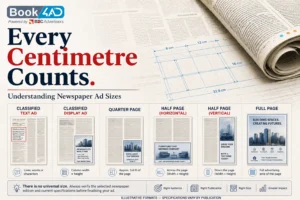
Newspaper advertisement cost can change according to the publication, edition, category, number of words or lines, display size, colour, publication day, premium position and available combination package.
The least expensive option is not automatically the best value. Nor is the largest advertisement automatically the most effective.
A better sequence is:
- Define the purpose of the advertisement.
- Identify the intended reader and location.
- Select the appropriate publication and edition.
- Choose the ad format.
- Prepare clear, complete copy.
- Compare the available rate and package options.
- Verify every detail before approving publication.
This turns rate checking into an informed advertising decision.
Book4Ad: making newspaper advertising easier to understand
Book4Ad was created around a simple problem: newspaper advertising information is often spread across publications, editions, categories, rate structures and booking conditions.
Our role is to help advertisers understand those choices more clearly.
The existing Book4Ad platform continues to provide access to available newspaper advertising options. Where a customer needs help selecting an edition, preparing the advertisement or confirming availability, our team can assist with the booking process.
As Book4Ad evolves, our focus remains unchanged: bringing greater clarity, convenience and practical advertising intelligence to newspaper ad booking.
Print’s role is changing—not vanishing
Print no longer stands alone at the centre of every media plan. It does not need to.
Its value today is more specific: trust, local relevance, deliberate attention and public visibility. Those qualities remain useful for businesses, families, institutions and individuals whose message must reach a particular audience with the right context.
The future of advertising will not be built by forcing every message into one medium. It will be built by understanding what each medium does well.
For many important announcements, that still leaves a meaningful place for the printed page.
Planning a newspaper advertisement?
Explore the available newspaper, edition and category options on Book4Ad. If you are uncertain about the right selection, contact the Book4Ad team for assisted booking support.
Ready to book your newspaper ad?
Live rates, all major papers, published as early as tomorrow morning.
#Book4Ad#Classified Ads#Newspaper Ad Booking#Newspaper Advertising#Print Advertising#Regional Advertising