A practical guide to booking a newspaper advertisement online in India—covering categories, formats, newspapers, editions, rates, publication dates and final proof approval.
A newspaper advertisement may occupy only a few lines or a small part of a page. Booking it correctly, however, involves several decisions.
Which category should you choose? Is Classified Text enough, or does the message need a designed layout? Which newspaper and edition will reach the intended readers? What determines the rate? How early should the advertisement be submitted?
A mistake in any of these choices can increase the cost, delay publication or place the advertisement before the wrong audience.
Online newspaper ad booking makes the process more convenient, but convenience does not remove the need for careful selection. This guide explains what to prepare, what to check and how to move from an advertising requirement to a confirmed newspaper booking.
What kinds of newspaper advertisements can be booked online?
Newspapers carry advertisements for individuals, families, businesses, institutions and public organisations.
Common categories include:
- matrimonial;
- property for sale;
- property to rent;
- recruitment and appointments;
- education;
- business;
- public notices;
- name change;
- lost documents;
- obituary and remembrance;
- tenders;
- vehicles;
- travel;
- retail;
- services;
- personal announcements.
Category names and availability differ between newspapers. An advertisement accepted under one heading by one publication may be classified differently by another.
Start with the genuine purpose of the advertisement. Do not select an unrelated category merely because it appears cheaper.
Understand the three main newspaper-ad formats
The first important decision is whether the advertisement should be Classified Text, Classified Display or Display.
Classified Text advertisement
A Classified Text ad appears as running matter under a category heading.
It is generally suitable when:
- the message is short and factual;
- a logo or photograph is unnecessary;
- the advertiser’s priority is an economical format;
- the essential details fit within a limited number of lines, words or characters.
Depending on the newspaper, the cost may be calculated according to lines, words, characters or a fixed classified package.
Some publications may offer paid enhancements such as:
- bold type;
- capital letters;
- tick marks;
- borders;
- background colour.
Availability and charges for these enhancements must be confirmed for the selected newspaper.
Classified Display advertisement
A Classified Display ad provides more control over presentation while remaining within the newspaper’s classified section.
It may include:
- a logo;
- photograph;
- border;
- different font sizes;
- structured headings;
- visual hierarchy;
- more detailed information.
This format is often considered for recruitment, property, education, matrimonial, obituary and business advertisements that need stronger visibility.
Classified Display advertisements are usually priced according to their area, subject to the newspaper’s accepted column widths and minimum sizes.
Display advertisement
A Display advertisement provides greater freedom in size, layout and placement.
It may be appropriate for:
- brand campaigns;
- retail promotions;
- real-estate projects;
- institutional recruitment;
- school or university admissions;
- corporate announcements;
- product launches;
- public-awareness campaigns.
Display advertisements may range from small custom sizes to quarter-page, half-page and full-page formats.
The newspaper, edition, page position, colour option, size and publication date can all affect the final cost.
Which format should you choose?
| Requirement | Format to consider |
|---|---|
| Short factual message without a logo or photograph | Classified Text |
| Small advertisement requiring a logo, portrait or structured layout | Classified Display |
| Large institutional, retail or branding campaign | Display |
| Legal, identity-related or public announcement | Applicable category and publisher-approved format |
| Advertisement containing several products, courses or vacancies | Classified Display or Display |
| Local tutor, service or compact property requirement | Classified Text may be sufficient |
The shortest or cheapest format is not always the most economical choice.
A long Classified Text advertisement may become expensive if it is charged line by line. In some cases, a compact Classified Display layout may organise the same information more clearly.
Prepare the matter first, then compare the available formats.
Choose the correct advertisement category
The category determines where the advertisement appears and may affect:
- pricing;
- permitted wording;
- available formats;
- required documents;
- publication schedule;
- editorial approval.
For example:
- a house offered for rent belongs under the applicable Property or To-Let category;
- a vacancy belongs under Recruitment or Appointments;
- a missing certificate may require Lost Documents;
- a death-anniversary tribute may belong under Remembrance rather than Obituary;
- a legal announcement may require Public Notice or another publication-specific heading.
Selecting the wrong category can place the advertisement before an irrelevant audience or lead to rejection.
If the wording could fit more than one category, ask the booking team to confirm the appropriate classification before payment.
Choose a newspaper based on the intended reader
A well-known newspaper is not automatically the right choice for every advertisement.
Ask:
Who needs to see this message, and which newspaper are they likely to read?
Consider:
- city or district;
- language;
- audience profile;
- purpose of the advertisement;
- local versus wider reach;
- budget;
- category availability;
- required publication date.
A Telugu newspaper may be appropriate for an announcement intended mainly for Telugu-speaking readers. An English publication may suit a professional or urban audience. A strong local newspaper may perform a more relevant role than a national publication when the requirement is limited to one city or district.
The objective is not simply to buy the largest circulation. It is to select useful circulation.
Select the right city or edition
Newspapers commonly publish several city, district or regional editions. These editions do not necessarily carry identical advertisements, categories, rates or packages.
Choose the edition according to the audience you need to reach.
Examples:
- A local vacancy in Hyderabad may not need publication across an entire state.
- A matrimonial advertisement may require several cities or a larger regional package.
- A property advertisement should target readers likely to buy or rent in the relevant location.
- A public notice may need an edition determined by legal or professional advice.
- A university campaign may require multiple editions.
Do not assume that selecting a newspaper automatically includes all its editions.
Confirm:
- newspaper;
- city or edition;
- number of editions;
- coverage;
- category availability;
- applicable package.
If a required edition is unavailable for the selected category, check whether another edition or combination offers meaningful coverage.
Prepare the advertisement matter
Good advertisement matter is complete, concise and easy to verify.
The information required depends on the category, but may include:
- purpose of the advertisement;
- name of the person or organisation;
- property, job, course or service details;
- location;
- dates;
- eligibility or qualifications;
- price, salary or commercial terms;
- contact number;
- email or website;
- mandatory declaration;
- registration, licence or reference information.
Begin with the information the reader needs most.
Property example
FOR SALE: Residential plot measuring [AREA] at [LOCATION]. Clear title. Price [AMOUNT OR NEGOTIABLE]. Contact: [PHONE NUMBER].
Recruitment example
REQUIRED: [JOB ROLE] for [BUSINESS OR INSTITUTION] at [LOCATION]. Candidates with [QUALIFICATION OR EXPERIENCE] may apply. Contact: [PHONE OR EMAIL].
Education example
ADMISSIONS OPEN: Applications invited for [COURSE OR GRADES] at [INSTITUTION], [LOCATION]. Last date: [DATE]. Details: [WEBSITE OR PHONE].
Lost-document example
LOST: [DOCUMENT NAME AND NUMBER] belonging to [NAME], lost near [LOCATION] on [DATE]. Finder may contact [PHONE NUMBER].
These are structural examples only. Final wording should reflect the advertiser’s facts and the selected newspaper’s rules.
Check whether documents are required
Some categories may require supporting documents before a newspaper accepts the advertisement.
These can include:
- name-change advertisements;
- lost documents;
- public notices;
- legal announcements;
- identity-related declarations;
- obituary or death announcements;
- tenders;
- regulated institutional advertisements.
Requirements vary by publication, category and wording. Do not assume that one document is compulsory for every newspaper.
Confirm what is required before choosing an urgent publication date. Share only the necessary documents through an approved booking channel.
The newspaper’s editorial team may request clarification or additional proof before accepting the advertisement.
Choose the publication date carefully
A preferred date is not automatically a confirmed date.
Allow time for:
- matter review;
- document verification;
- artwork preparation;
- proof corrections;
- newspaper editorial approval;
- payment confirmation;
- applicable production deadlines.
Certain advertisements must appear on a fixed date, such as:
- death-anniversary notices;
- prayer-meeting announcements;
- tenders;
- auction notices;
- admission deadlines;
- event announcements;
- legal notices.
Start those bookings early.
Next-day publication may be possible for some newspapers and categories, but it depends on the submission time, edition, matter, documents, artwork, payment and production deadline.
Do not promise or assume a publication date until it is confirmed.
How is newspaper advertising cost calculated?
There is no single rate for all newspaper advertisements.
The cost may depend on:
- newspaper;
- edition;
- category;
- advertisement format;
- number of lines, words or characters;
- display width and height;
- black-and-white or colour publication;
- page position;
- weekday or special publication date;
- number of insertions;
- combination packages;
- enhancements;
- applicable taxes.
Classified Text pricing
The publication may charge according to:
- line;
- word;
- character;
- fixed minimum package.
The minimum charge may apply even when the advertisement is shorter than the newspaper’s required minimum.
Classified Display and Display pricing
For many display products:
Advertisement area = width × height
For example, an advertisement measuring:
8 cm × 5 cm
occupies:
40 square centimetres
The applicable rate may then be calculated using the newspaper’s pricing structure for that edition, category and date.
This is only the basic area calculation. Minimum sizes, fixed column widths, colour charges, premiums, packages and taxes may also apply.
Why current rates matter
Newspaper tariffs, packages and category rules may change.
Check the current rate for the exact:
newspaper + edition + category + format + publication date
Do not treat an old screenshot, forwarded quotation or previous invoice as the final price for a new booking.
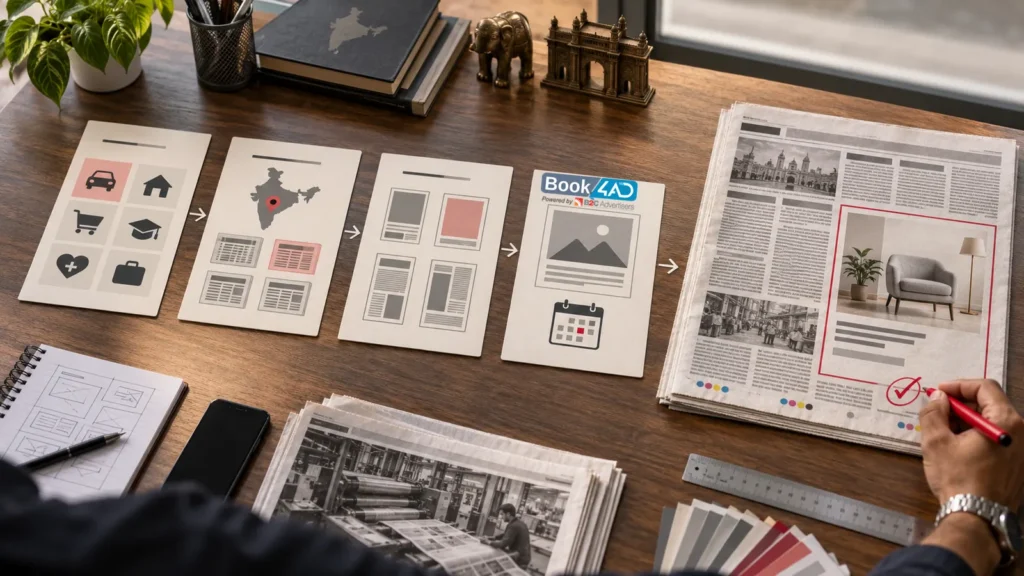
How to book a newspaper advertisement online
The exact screen order may differ according to the booking route, but a complete booking normally involves the following decisions.
Step 1: Identify the advertisement purpose
Start with what needs to be published.
Determine whether it is a matrimonial proposal, property requirement, vacancy, public notice, name change, education announcement, obituary or another category.
Step 2: Select the category
Choose the closest genuine category and subcategory available for the advertisement.
If the category is unclear, confirm it before proceeding.
Step 3: Choose the newspaper and edition
Select the newspaper, language and city or edition according to the intended audience.
Check whether a single edition or an available combination is more appropriate.
Step 4: Choose the advertisement format
Select Classified Text, Classified Display or Display according to:
- amount of information;
- need for a logo or photograph;
- desired visibility;
- accepted newspaper specifications;
- available budget.
Step 5: Prepare or enter the advertisement matter
Enter the final text or upload the prepared artwork.
Include accurate contact information and any mandatory details. Upload a clear logo or photograph only when the chosen format allows it.
Step 6: Select the publication date
Choose the preferred date and check whether there is sufficient time for review, payment and newspaper approval.
Step 7: Review the rate and package
Check:
- newspaper;
- edition;
- category;
- format;
- number of lines or final dimensions;
- enhancements;
- publication date;
- taxes;
- final payable amount.
Step 8: Review the proof
Read the advertisement as though it has already appeared in the newspaper.
Check every name, date, number, address and claim.
Step 9: Complete the booking
Proceed after the advertisement details, rate, proof and intended publication date have been verified.
Keep the acknowledgement, invoice or booking reference for follow-up.
Review the final proof before approval
A small mistake can make an advertisement ineffective or require a corrected insertion.
Check:
- names and spellings;
- initials and titles;
- phone numbers;
- email addresses;
- website;
- dates;
- prices;
- salary;
- property measurements;
- document numbers;
- location;
- category;
- newspaper;
- edition;
- photograph or logo;
- final dimensions;
- publication date.
If the advertisement concerns legal, financial, institutional or identity-related information, ask the responsible person or adviser to verify the final wording.
Do not approve an advertisement merely because its design looks correct.
Common newspaper-booking mistakes
Selecting the wrong category
An incorrect category may result in rejection or poor placement.
Choosing the newspaper without checking the edition
A newspaper may have several editions with different coverage and rates.
Preparing artwork before confirming the size
Newspapers may use publication-specific column widths and minimum dimensions. Confirm the accepted size before completing production artwork.
Using too much information
A crowded advertisement can become difficult to read and unnecessarily expensive.
Omitting the response method
Readers need a correct phone number, email, website or other enquiry route.
Using an old rate
Tariffs and packages can change. Request a current quotation.
Waiting until the deadline
Late submission leaves little time for corrections, documents and approval.
Approving without checking numbers
Phone numbers, dates, prices, measurements and document references deserve a separate review.
Assuming payment guarantees publication
Advertisements remain subject to the newspaper’s editorial acceptance, deadlines, category rules and applicable documentation.
What happens after the booking?
After the booking is submitted, the advertisement may move through:
- payment confirmation;
- matter or artwork review;
- document verification, where applicable;
- newspaper editorial acceptance;
- scheduling for the confirmed edition and date;
- publication.
If the newspaper requests a correction or document, respond before the applicable deadline.
Retain:
- approved advertisement proof;
- invoice;
- payment confirmation;
- booking reference;
- newspaper and edition details;
- confirmed publication date.
If publication proof is required, request information about its availability through the booking-support channel.
Before booking: final checklist
Keep the following ready:
- advertisement category;
- complete matter;
- newspaper preference;
- required city or edition;
- Classified Text, Classified Display or Display preference;
- preferred publication date;
- logo or photograph, if applicable;
- supporting documents, if required;
- correct contact details;
- approved budget.
Before payment, confirm:
- category;
- newspaper;
- edition;
- advertisement format;
- final matter;
- dimensions or text length;
- publication date;
- current rate;
- taxes;
- final proof.
Book a newspaper advertisement through Book4Ad
Book4Ad helps advertisers explore newspaper, edition, category and advertising-format options for newspaper bookings across India.
Check Newspaper Advertisement Rates
Need help selecting the category, edition or format?
Call or WhatsApp the Book4Ad team on +91 90301 19494.
Publication is subject to the selected newspaper’s current rates, deadlines, editorial approval, category rules, documentation requirements, availability and payment confirmation.
Frequently asked questions
Can I book a newspaper advertisement online?
Yes. You can select the advertisement category, newspaper, edition, format and publication date online, subject to the options available for that booking.
What types of newspaper advertisements can be booked?
Common categories include matrimonial, property, recruitment, education, public notice, name change, lost documents, obituary, remembrance, tenders, business and services.
What is the difference between Classified Text and Classified Display?
Classified Text is primarily a running-text format and is commonly priced by lines, words or characters. Classified Display provides more layout control and may allow a logo, photograph, border and different type sizes.
How do I choose the right newspaper?
Choose according to the location, language and readership of the people you need to reach. The newspaper with the widest circulation is not automatically the most relevant option.
What is a newspaper edition?
An edition is a city, district or regional version of a newspaper. Rates, coverage, categories and packages may differ between editions.
How much does a newspaper advertisement cost?
The cost depends on the newspaper, edition, category, format, line count or display size, colour option, publication date, number of insertions and available packages.
Can I publish an advertisement tomorrow?
It may be possible for certain newspapers and categories, depending on submission time, documents, artwork, payment and production deadlines. The date is final only after confirmation.
Are documents required for every advertisement?
No. Documentation depends on the category, wording and newspaper. Legal, identity-related and certain public announcements are more likely to require supporting proof.
Can I include a photograph or logo?
A photograph or logo may be included when the selected format and newspaper specifications permit it. It is generally associated with Classified Display or Display advertising rather than basic Classified Text.
Can the advertisement be changed after payment?
Changes depend on whether the booking remains within the newspaper’s correction window. Modification may not be possible after the production deadline.
How will I know whether the advertisement is confirmed?
Retain the booking acknowledgement, approved proof, invoice and confirmed publication date. Contact the booking team if any of these details remain unclear.
Can Book4Ad help prepare the advertisement matter?
Book4Ad can assist with formatting the information supplied by the advertiser. The advertiser remains responsible for checking names, numbers, claims, dates and supporting documents before approval.
Ready to book your newspaper ad?
Live rates, all major papers, published as early as tomorrow morning.
#book ads online#book classified ads online#book classified ads online in newspapers#classified ads in newspapers