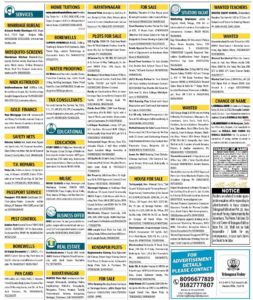
Admissions Open. Make the Message Count.
A practical guide to writing and booking an education advertisement in a newspaper, with adaptable samples for school admissions, colleges, coaching institutes, courses and private tutors.
Education advertising has one unusual challenge.
Parents and students are rarely searching for an advertisement. They are searching for an answer.
A parent may be comparing schools within travelling distance. A Class XII student may be considering degree programmes. A graduate may be preparing for a competitive examination. Another family may need a reliable tutor close to home.
A newspaper education advertisement works best when it answers four questions quickly:
What is being offered? Who is it for? Where is it available? What should the reader do next?
Many advertisements fail at one of two extremes. They either squeeze an entire prospectus into a small space or say little more than:
Admissions Open. Contact Now.
One overwhelms the reader. The other gives the reader no reason to respond.
A useful education advertisement sits between those extremes: clear enough to understand within seconds and specific enough to prompt the right enquiry.
What is an education advertisement in a newspaper?
An education advertisement is a Classified Text, Classified Display or Display advertisement published by a school, college, university, coaching centre, training institute, tutor or another education provider.
It may promote:
- school or preschool admissions;
- undergraduate or postgraduate programmes;
- coaching for competitive examinations;
- vocational and professional courses;
- language classes;
- computer training;
- study-abroad services;
- distance or online programmes;
- home tuition;
- subject-specific tutoring;
- open houses and counselling sessions;
- scholarship or entrance-test information.
The precise category name and available formats can differ between newspapers. Confirm the applicable Education category before preparing the final advertisement.
What can be advertised under Education?
Education is a broad newspaper category. The right message depends on the institution, intended student and decision being promoted.
Schools and preschools
Schools may advertise:
- nursery or preschool admissions;
- admissions for selected grades;
- primary or secondary admissions;
- open-house dates;
- new campuses or branches;
- application deadlines;
- scholarship or entrance-test information.
For a local school, the advertisement should make the campus location and applicable grades easy to find.
Colleges and universities
Higher-education advertising may cover:
- undergraduate programmes;
- postgraduate programmes;
- professional courses;
- diploma or certificate programmes;
- entrance requirements;
- application dates;
- counselling schedules;
- admissions to a new academic session.
These advertisements must remain consistent with the institution’s official admission notification, prospectus and applicable approvals.
Coaching institutes
Coaching advertisements commonly promote:
- JEE preparation;
- NEET preparation;
- UPSC coaching;
- banking examinations;
- SSC and other government examinations;
- CA, CMA or CS coaching;
- board-examination preparation;
- language and communication training;
- computer and technical courses.
The examination, batch, location and commencement date should be immediately visible.
Tutors and tuition providers
Individual tutors or tuition centres may advertise:
- home tuition;
- subject-specific tuition;
- support for particular classes or boards;
- board-examination preparation;
- language instruction;
- music or skill-based lessons;
- online or classroom tuition.
Location is especially important for home tuition and small classroom batches.
What should an education advertisement include?
Start with the reader’s decision, not the institution’s history.
Institution or service name
Make it clear who is offering the programme, admission or tuition service.
Use the institution’s correct registered or publicly used name. If a logo is included, use the approved original artwork.
Clear offer
State exactly what is available.
For example:
Admissions Open — Nursery to Grade VIII
NEET Preparation — New Batch
Mathematics Home Tutor — Classes VIII to XII
The reader should not have to study the entire advertisement to understand its purpose.
Intended students
Mention the relevant grades, courses, examination, age group or eligibility.
Examples include:
- Nursery to Grade V;
- Classes VIII to XII;
- undergraduate applicants;
- engineering or medical entrance aspirants;
- graduates preparing for competitive examinations.
Location
Location strongly influences education enquiries, particularly for schools, tutors and classroom coaching.
Mention the relevant:
- locality;
- city;
- campus;
- branch;
- service area.
Do not use a broad edition when the service is available only within a small local area unless wider reach is genuinely required.
Course or programme details
Include the information needed to determine relevance, such as:
- course or programme name;
- class or grade;
- mode of instruction;
- batch type;
- duration, where important;
- entrance or eligibility requirement.
A newspaper advertisement does not need to reproduce the complete syllabus or prospectus.
Important dates
Depending on the advertisement, mention:
- application opening date;
- last date to apply;
- entrance-test date;
- counselling date;
- open-house date;
- batch commencement date;
- academic year.
Dates create urgency only when they are accurate and meaningful.
Response method
Give the reader a clear next step:
- call;
- visit the official website;
- submit an enquiry;
- attend an open house;
- visit the campus;
- scan a QR code, if permitted and suitable for the printed size.
Check every phone number, web address and QR code before approving the advertisement.
School admission advertisement samples
The following examples are drafting references. Replace all placeholders with accurate institutional information.
Sample 1: School admissions
ADMISSIONS OPEN — [ACADEMIC YEAR]
Admissions open for Nursery to Grade VIII at [SCHOOL NAME], [LOCATION].
Applications are now available.
For admission details, visit [WEBSITE] or contact [PHONE NUMBER].
Sample 2: Preschool admissions
ADMISSIONS OPEN
Playgroup, Nursery and Kindergarten admissions are now open at [PRESCHOOL NAME], [LOCALITY].
For application and campus-visit details:
[PHONE NUMBER / WEBSITE]
Sample 3: New school campus
NOW ADMITTING
[SCHOOL NAME] — [NEW CAMPUS LOCATION]
Admissions open for [GRADES] for the academic year [YEAR].
Application and campus-visit details: [CONTACT INFORMATION]
These advertisements deliberately avoid listing every activity, facility and feature. Detailed information can be provided through the school website, prospectus or admissions team.
Image caption: A school-admission advertisement should allow parents to identify the grades, campus, academic year and enquiry route within a few seconds.
College and university advertisement samples
Sample 4: Degree programmes
ADMISSIONS OPEN
Applications invited for [PROGRAMME NAMES] at [COLLEGE OR UNIVERSITY] for the academic year [YEAR].
Eligibility and application details are available at [OFFICIAL WEBSITE].
Last date to apply: [DATE]
Sample 5: Professional programme
APPLICATIONS INVITED
Admissions open for [COURSE NAME] at [INSTITUTION], [CITY].
Eligibility: [BRIEF REQUIREMENT]
Apply before [DATE].
Details: [OFFICIAL WEBSITE / CONTACT NUMBER]
Sample 6: Entrance test or counselling notice
ADMISSION NOTICE
Applications are invited for [PROGRAMME] at [INSTITUTION].
Entrance test or counselling: [DATE AND TIME]
Venue or application portal: [DETAILS]
Eligibility and instructions: [OFFICIAL WEBSITE]
Formal admission information should match the institution’s approved prospectus or official notification.
Coaching-class advertisement samples
Sample 7: NEET coaching
NEET COACHING — NEW BATCH
Admissions open for [YEAR] NEET preparation at [INSTITUTE NAME], [LOCATION].
Batch commences on [DATE].
For programme details and enrolment: [CONTACT INFORMATION]
Sample 8: JEE coaching
JEE MAIN & ADVANCED COACHING
New classroom batch starting on [DATE] at [INSTITUTE NAME], [LOCALITY].
For schedule, eligibility and admission information:
[PHONE NUMBER / WEBSITE]
Sample 9: Banking and competitive examinations
BANKING & SSC COACHING
New classroom batch starting at [LOCATION].
Preparation available for [EXAMINATIONS].
Enrolment: [PHONE NUMBER / WEBSITE]
Avoid promises such as “100% guaranteed selection” unless the statement is accurate, supportable and permitted. A specific, verifiable claim is more credible than an exaggerated promise.
Image caption: A coaching advertisement needs a prominent examination name, batch date, location and response method; the institute’s complete brochure can remain online.
Tuition advertisement samples
Sample 10: Home tutor
HOME TUTOR AVAILABLE
Experienced Mathematics tutor for Classes VIII to XII, [BOARD, IF RELEVANT], in and around [LOCALITY].
Contact: [PHONE NUMBER]
Sample 11: Tuition centre
SCIENCE & MATHEMATICS TUITION
Classes available for [GRADES / BOARD] at [TUITION CENTRE], [LOCATION].
Weekday and weekend batches available.
Enquiries: [CONTACT INFORMATION]
Sample 12: Language classes
SPOKEN ENGLISH CLASSES
Weekday and weekend batches available at [LOCATION].
New batch commences on [DATE].
Enquiries: [PHONE NUMBER / WEBSITE]
Which advertisement format should you choose?
Education advertisements generally use one of three formats.
| Format | Generally suitable for | Common features |
|---|---|---|
| Classified Text | Tutors, small coaching batches and short course announcements | Compact text; normally charged according to the publication’s line, word or character structure |
| Classified Display | Schools, coaching centres and branded course announcements | Logo, border, visual hierarchy, different type sizes and structured information |
| Display Advertisement | Universities, large schools, multiple programmes, new campuses and major admission campaigns | Greater control over size, imagery, branding, layout and placement |
Rates, minimum sizes and available enhancements differ between publications and editions.
A simple format rule
One compact offer → Classified Text
Brand plus structured information → Classified Display
Large institutional campaign → Display Advertisement
A local tutor may need only a few clear lines. A university promoting several programmes, campuses and application dates may require a quarter-page or larger format.
Choose the format according to the communication requirement—not merely the institution’s size.
How to choose the right newspaper and edition
The newspaper with the widest circulation is not automatically the best choice for every education advertiser.
Start with the student or parent you need to reach.
For schools
Geography is usually central to the decision.
Consider:
- the school’s practical catchment area;
- campus location;
- transport reach;
- preferred language of parents;
- local readership of the newspaper.
A city-specific or regional edition may be more useful than unnecessarily broad circulation.
For coaching institutes
Consider:
- examination or course;
- student profile;
- institute location;
- classroom or online availability;
- language of instruction;
- cities from which students are realistically recruited.
A coaching institute serving students across several districts may need a broader combination than a neighbourhood tuition centre.
For colleges and universities
An institution recruiting students from several cities or states may consider:
- multiple editions;
- regional-language and English publications;
- city combinations;
- larger Display formats;
- repeated insertions around important admission dates.
For tutors
Local reach usually matters more than national visibility.
Select the newspaper and edition read within the localities where the tutor can actually provide classes.
When should an education advertisement be published?
Education advertising is seasonal, but the entire category does not follow one common calendar.
School and college admissions
Campaign timing should follow:
- application opening;
- the institution’s academic calendar;
- entrance examinations;
- board or qualifying results;
- counselling;
- remaining seat availability.
Do not wait until the application deadline is too close for readers to respond.
Coaching institutes
Plan around:
- examination schedules;
- new-batch commencement;
- school or college results;
- the period when students compare coaching options;
- availability of classroom seats.
A single insertion may create awareness, but several well-timed insertions can support recall during a longer decision period.
Tutors and tuition centres
Useful periods may include:
- the beginning of an academic term;
- the weeks before major examinations;
- board-examination preparation;
- the start of a new subject or syllabus;
- the opening of a new local batch.
The practical rule is simple:
Advertise when the student or parent is making the decision—not merely when the institution has advertising space available.
What determines the cost of an education advertisement?
There is no single nationwide education-advertising price.
The cost may depend on:
- newspaper;
- city or edition;
- language;
- Classified Text, Classified Display or Display format;
- number of lines, words or characters;
- advertisement width and height;
- black-and-white or colour publication;
- page or section;
- number of editions;
- publication dates;
- single or multiple insertions;
- available packages;
- applicable taxes.
For an accurate quotation, check the current rate for the selected newspaper, edition, Education category and advertisement format.
An old rate card, screenshot or forwarded quotation may not reflect current tariffs, packages or edition availability.
Verify every education claim before publication
Education advertising can influence an important financial and academic decision. Every claim should therefore be checked before the advertisement is released.
Verify statements concerning:
- recognition;
- affiliation;
- accreditation;
- rankings;
- examination results;
- selections;
- placements;
- salary outcomes;
- scholarships;
- faculty;
- infrastructure;
- international partnerships;
- course approval;
- distance or online learning status.
Do not describe an institution or programme as recognised, approved or affiliated unless that claim is current and supported by the appropriate authority.
Avoid claims such as:
- No.1 institute;
- guaranteed placement;
- guaranteed selection;
- 100% results;
- best school;
- world-class faculty;
unless the advertiser has reliable evidence and the wording complies with applicable requirements.
For regulated, professional, distance or online programmes, confirm the relevant authority and approval status before publication. The advertiser remains responsible for the accuracy and substantiation of all claims.
Common mistakes in education advertising
Trying to fit the entire prospectus
A newspaper advertisement should help the reader recognise a relevant opportunity and take the next step.
The website, prospectus or admissions team can provide the full details.
Using a generic headline
“Best Education Available” says very little.
“Admissions Open — Nursery to Grade VIII” immediately tells the parent why the advertisement matters.
Giving equal importance to everything
A strong education advertisement needs hierarchy:
Offer → institution → intended student → location → important date → response
If every line is large and bold, nothing receives attention.
Missing the location
Location can determine whether a school, tutor or coaching centre is practical for the reader.
Missing the deadline
If applications close on a specific date, make the deadline easy to find.
Making unsupported claims
Recognition, rankings, results, placements and scholarship claims should be checked before publication.
Selecting the wrong edition
A local institution may waste its budget by purchasing circulation far beyond its actual catchment.
Using incorrect contact information
An attractive advertisement cannot produce useful enquiries if the phone number, website or QR code is wrong.
Leaving too little time for approval
Allow time for artwork preparation, proof corrections, rate confirmation, payment and the newspaper’s booking deadline.
A simple education-advertisement formula
For school admissions:
ADMISSIONS OPEN + SCHOOL + GRADES + CAMPUS LOCATION + ACADEMIC YEAR + CONTACT
For college admissions:
APPLICATIONS INVITED + INSTITUTION + PROGRAMMES + ELIGIBILITY + LAST DATE + OFFICIAL WEBSITE
For coaching:
EXAMINATION OR COURSE + NEW BATCH + LOCATION + START DATE + CONTACT
For tutors:
SUBJECT + CLASS LEVEL + LOCATION + RELEVANT EXPERIENCE OR QUALIFICATION + CONTACT
The formula keeps the advertisement focused on the reader’s decision instead of filling the space with decoration.
Final advertisement checklist
Before approving the advertisement, verify:
- institution or tutor name;
- logo;
- course, grade or examination;
- campus or class location;
- eligibility;
- academic year;
- application deadline;
- batch commencement date;
- phone number;
- official website;
- QR code;
- recognition or affiliation claim;
- results, rankings or placement claims;
- newspaper;
- edition;
- advertisement format;
- final dimensions;
- publication date;
- colour or black-and-white selection;
- final payable amount.
Then ask one final question:
Can the intended parent or student understand the offer and next step within a few seconds?
If not, simplify the advertisement before publication.
How to book an education advertisement in a newspaper
Once the advertisement details are ready:
- Select the Education category.
- Choose the required newspaper.
- Select the appropriate city or edition.
- Choose Classified Text, Classified Display or Display.
- Enter the advertisement matter or upload the prepared artwork.
- Select the intended publication date.
- Check the available rate or package.
- Review all claims, dates and contact details.
- Approve the final proof.
- Complete the booking after confirming the details.
Planning an admissions, coaching or tuition campaign?
Book4Ad allows advertisers to explore available Education advertising options by newspaper and edition.
Check Education Advertisement Rates
Need help selecting a format or preparing the advertisement?
Contact the Book4Ad team for assisted booking.
Publication remains subject to the selected newspaper’s deadlines, category rules, editorial approval, format availability, applicable documentation and payment confirmation.
Frequently asked questions
What is an education advertisement in a newspaper?
It is a Classified Text, Classified Display or Display advertisement promoting a school, college, university, coaching institute, course, tuition centre or other education-related service.
How do I write a school-admission advertisement?
Begin with “Admissions Open”, followed by the school name, grades, campus location, academic year, important application date and enquiry method.
What should a coaching advertisement contain?
Mention the examination or course, batch, location, commencement date and response method. Include only accurate and relevant differentiators.
Can a private tutor advertise in a newspaper?
Yes. A tutor can use an appropriate Education or tuition-related newspaper category, subject to the publication’s available classifications and booking rules.
Is Classified Text suitable for education advertising?
Classified Text can suit tutors, small coaching batches and short course announcements. Schools and larger institutions may need Classified Display or Display formats for stronger hierarchy and branding.
Which newspaper should a school choose?
Choose according to the school’s catchment, campus location, language and parent readership rather than selecting the widest possible circulation by default.
When should coaching institutes advertise?
Timing should follow examination cycles, batch commencement dates and the period in which students are actively comparing preparation options.
Can an institute claim guaranteed results or placements?
Such claims should not be used unless they are accurate, permitted and supported by reliable evidence. Recognition, results, rankings and placement statements must be verified before publication.
How much does an education newspaper advertisement cost?
The cost depends on the newspaper, edition, format, line count or display size, colour option, publication dates and available packages. Check the current rate for the exact booking combination.
Can I advertise in a regional-language newspaper?
Yes, provided the selected publication and edition offer the relevant Education advertising category. A regional-language newspaper may be particularly useful when it matches the language of the intended students or parents.
Can Book4Ad help prepare the advertisement?
Book4Ad can assist with the appropriate format and preparation of the supplied advertising matter. The advertiser remains responsible for verifying all institutional claims, dates, course information and contact details before approval.
Can the advertisement be published the next day?
It depends on the newspaper, edition, format, submission time, artwork, payment and production deadline. The publication date is confirmed only after the booking has been accepted.
Ready to book your newspaper ad?
Live rates, all major papers, published as early as tomorrow morning.
#book education advertisement online#book education advertisement online in newspaper#book education classified ads online#education ad online booking